
The Three Schools
Oracy
What Is Oracy?
Oracy is the ability to articulate ideas, develop understanding and engage with others through spoken language.
Oracy develops students' confidence, articulacy and capacity to learn.
Voice 21.
Oracy is…
Engaging with others ideas
Reasoning together
Listening to understand
Changing people’s minds
Telling compelling stories
Developing arguments
Expressing yourself
Speaking up for what you believe in
Oracy is the ability to communicate effectively and at The Three Schools, we want every child to find their voice. Our aim is to remove communication barriers and enable students to be confident and effective communicators. Teaching children oracy skills will not only enable pupils to increase confidence in talk, but equip them for their future.
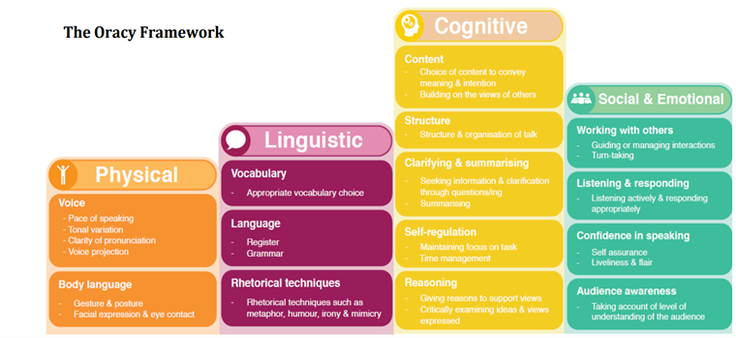
We use The Oracy Framework, which is made up of four strands (Physical, Linguistic, Cognitive, Social and Emotional- Taken from The Oracy Framework, Voice 21).
Staff at The Three Schools have had CPD on Oracy and Vocabulary and refer to Voicing Vocabulary from Voice21 as reference points- The-Voicing-Vocabulary-Report.pdf
Oracy across the Curriculum
Oracy is incorporated across our broad and balanced curriculum and pupils are given many opportunities to use their speaking and listening skills and develop their oracy skill set. Our school curriculum is rich in oracy opportunities:
- Maths- During maths lessons, children have opportunities to discuss their learning, knowledge and reasoning. Children are able to enquire about their learning through maths talk and daily number sense starter activities.
- Writing- In English lessons, our children engage in discussions in a range of contexts including; vocabulary, immersion, debates, questioning and feedback.
- Reading- In reading, children experience book talk, vocabulary and choral reading opportunities. Texts are discussed during reading lessons (vocabulary and comprehension) which are taught explicitly.
- Vocabulary- higher order (tier 2 and 3) vocabulary is shared and taught. Use of subject-specific language across all areas of the curriculum is used to support children's Oracy development and this is monitored through planning and book looks and pupil explanations of vocabulary.
- At The Three Schools, Oracy is at the heart of feedback and assessment for learning enabling children to discuss their work and any misconceptions. Teachers challenge children through probing questions about their learning.
- We use knowledge organisers across school that include many talking points for children to reflect on during their curriculum driver lessons. Each half term children have an enquiry question for each curriculum driver which all of their learning stems from, this enables many Oracy opportunities.
- ICT- Across the school, children are given opportunities in ICT to present what they have learnt in computing. For example, presenting Google slides to coding robots. Also sharing their knowledge with peers on how to complete a task.
- PE- Children actively engage with peer feedback and are encouraged to evaluate each lesson. Sports Captains lead and guide children in sports events and a focus active group weekly.
- Science- Scientific literacy is being developed through immersive experiences and children are encouraged to question their own predictions and results of experiments. The national curriculum for science reflects the importance of spoken language in pupils’ development across the whole curriculum – cognitively, socially and linguistically. Through lessons children learn scientific vocabulary and the ability to articulate scientific concepts clearly and precisely. The working scientifically objectives enable children to develop Oracy skills.
- Pupil voice- At The Three Schools, we have a Junior Leadership Team (JLT), House Captains and a Courageous Advocacy Team (CAT) where members along with teaching staff regularly attend meetings to listen, respect and act upon the views of the children. Children also have opportunities to discuss their learning with curriculum co-ordinator leads through pupil voice sessions.
- EYFS is the start of our pupils’ oracy journey through school. Staff encourage oracy from an early age through talking stories, retelling stories, scaffolding conversations during free flow time and circle time class discussions. Any barriers to oracy are spotted and acted upon here and interventions to assist with speech are put in place. Communication in Early Years is a prime learning area and enables children to meet other milestones at the end of the foundation stage.
At The Three Schools, we want every child to find their voice. Our aim is to remove communication barriers and enable students to be confident and effective communicators. Teaching children Oracy skills will not only enable pupils to increase confidence in talk, but equip them for their future.
The Oracy Framework
We use The Oracy Framework, which is made up of four strands;
- Physical,
- Linguistic
- Cognitive
- Social and Emotional
(Taken from The Oracy Framework, Voice 21)
At The Three Schools we are working hard to provide a high-quality Oracy education. With Oracy at the heart of our curriculum, we are committed to building and embedding a culture of Oracy.
Purposeful talk is used to drive forward learning, through talk in the classroom, which has been planned, designed, modelled, scaffolded and structured to enable all learners to develop the skills needed to talk effectively and with confidence.
The deliberate, explicit and systematic teaching of Oracy across phases and throughout the curriculum will support children to make progress in the four strands of Oracy (Physical, Linguistic, Cognitive, Social and Emotional- Taken from The Oracy Framework, Voice 21).
Oracy Documents
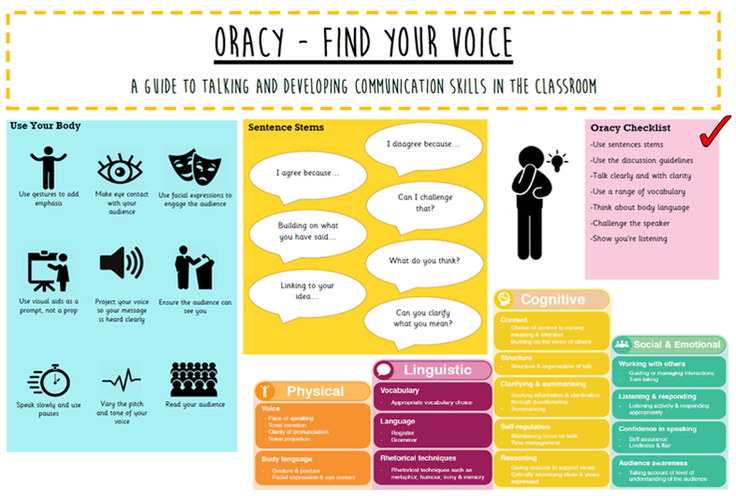
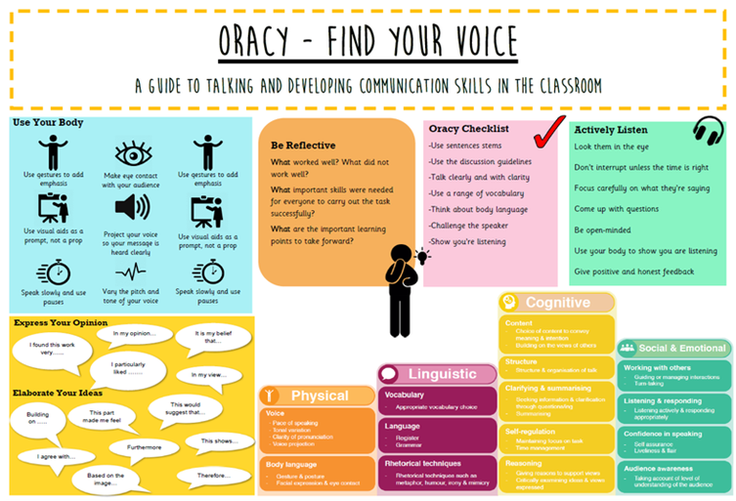
- The Three Schools Oracy Framework - Pupil Friendly PostersPDF File
- The Three Schools Oracy Discussion Guidelines - Pupil Friendly PostersPDF File
- The Three Schools Oracy Listening Ladder The Three SchoolsPDF File
- The Three Schools Oracy Talk Tactics - Pupil Friendly PostersPDF File
- The Three Schools Oracy Progression LadderPDF File
- The Three Schools Oracy Policy 2025-2026PDF File
- Talking-Like-A... Subject Specific Oracy SkillsPDF File